Cart
0
You know that pan. The one sitting in the sink with oil dried onto it from lunch, and now it's dinner, and you're staring at it like it personally did something to you. Water won't move that grease. It never does. Run the tap for ten minutes, and the oil just sits there, smug, unbothered, like it's daring you to try harder.
Here's the thing though, most people don't actually think about what's happening in that bottle by the sink. It just sits there next to the tap, doing its job quietly, until one day it doesn't. This happens because you get a new bottle of it, it does not have much cleaning power, and now you are stuck with the same pan twice the time you were earlier, without any fault on your part. Not all dishwashing liquids are created equal, and their effectiveness becomes apparent especially when it matters the most when you have your elbows deep in a pot that should have been cleaned up already in just five minutes.
If you need a quick and direct answer: Dishwashing liquid is a cleaning fluid used to clean grease, food, and dirt from dishes.
What Is Dishwashing Liquid?
Well, it is what you put in a sponge when washing your dishes, including plates, cups, cutlery, and cookware manually. Just a few drops of it mixed with water and effort. Manual effort, that is. A great number of people think dishwasher detergent and dishwashing liquid are the same products. In reality, they are not, and the gap between the two is quite significant once we look at their formulae. Hand dishwashing liquid is designed to produce foam and be used on a sponge, while dishwasher detergent is used in a machine, which cannot withstand any foaming products and therefore remains a low-foam product.
Have you ever accidentally put the dishwashing liquid into a dishwasher? Then you surely know the result. Lots of foam. All over your kitchen floor too. Water alone cannot clean any greasy stains because oil does not mix with water and forms a separate layer on top. That is the main purpose of the product.
How Does Dishwashing Liquid Remove Grease?
Surfactants do the actual work here, and once you understand how, it's oddly satisfying. Each surfactant molecule has two sides, one pulled toward water, the other toward oil. Drop dishwashing liquid on a greasy plate, and the oil-loving side grabs onto the grease while the water-loving side faces out, into the water. The grease lifts off the dish and stays suspended there instead of clinging stubbornly to the surface. Rinse, and it's gone, down the drain with everything else.
That's the whole trick, really. Water plus surfactants loosen the grease, food residue floats free, and rinsing wraps things up. Anionic and non ionic surfactants both turn up in most formulas, and they're not doing the same job. One mostly drives the cleaning power, the other shapes how the mixture behaves as you're washing.
Quick note on foam, because people get this wrong constantly. More foam doesn't mean more cleaning power. Never has. Foam mostly just keeps the liquid sitting on a surface a bit longer. A low-foam dishwashing liquid cuts grease just as well as one that bubbles up like crazy in your hands, so don't judge a bottle by how much it foams.
What Is Inside Dishwashing Liquid?
Not every dishwashing liquid has enzymes in it. Check your own bottle's label if you actually want to know what's in yours.
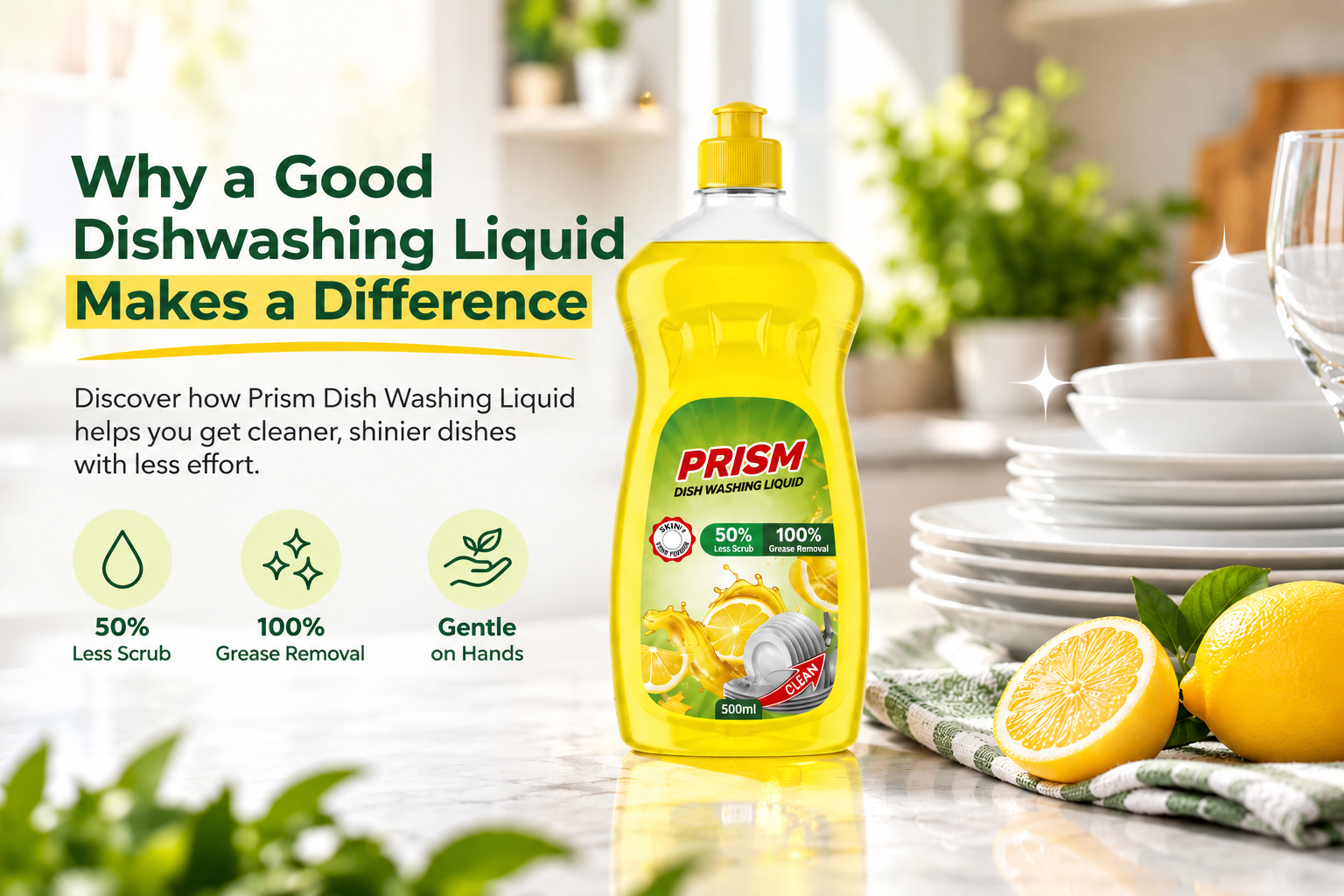
Tired of scrubbing the same greasy pan twice? A good dishwashing liquid shouldn't make you work that hard. Try Prism's dishwashin
Benefits of Using an Effective Dishwashing Liquid
g liquid and see the difference one wash makes.
Grease and oil actually lift off, instead of smearing around the plate. Dried food loosens on its own instead of you scraping at it with a fingernail. Washing up just takes less time overall, and you're not scrubbing hard enough to leave marks on your hand by the time you're done. It handles most kitchenware fine too, glasses, cutlery, even the heavier pots. And when you rinse properly, dishes actually come out clean. Not just wet and soapy-smelling. Actually clean.
How to Use Dishwashing Liquid Effectively
Scrape off whatever food's still sitting on the plate, then wet the dishes under running water. Put a reasonable amount of liquid on your sponge, not a mountain of it, and scrub so the foam spreads across the whole dish rather than one spot. Greasy areas, pan bottoms mostly, need a bit more time. Rinse until there's genuinely no foam left, check twice if you're not sure, then air dry or towel dry if you're in a rush.
That rinsing step is where people mess up most, honestly. Half-rinsed dishes leave a soapy film behind, and nobody wants that on their fork mid-meal.
How to Choose a Good Dishwashing Liquid
-
Grease-cutting power matters more than anything else on this list. A dishwashing liquid's entire job is cutting through oil and grease, and if it struggles on a genuinely greasy pan, nothing else about it really counts for much.
-
A clean rinse is non-negotiable too. Some liquids leave a slippery film behind even after a good rinse, which usually means the formula leans too heavily on thickening agents. Worth steering clear of.
-
Consistency matters more than people think, mostly because it affects how much product you actually go through. Too watery and you end up pouring more each time just to get the same result. Too thick and it's a hassle to squeeze out and control. Somewhere balanced in the middle tends to be better value over time.
-
Fragrance, on the other hand, is purely a preference thing. It has nothing to do with how well the liquid actually cleans, so pick a scent you like and don't overthink it.
-
A decent all-purpose formula should also handle whatever in your sink without extra effort, plates, glasses, cutlery, pots and pans, all of it, without needing to switch products depending on what you're washing.
-
Clear usage instructions matter more than they get credit for. A label that tells you exactly how much to use keeps you from wasting product, and that adds up over time more than most people expect.
-
And brand trust, when it's real, comes from consistency rather than marketing. A brand worth sticking with delivers the same grease-cutting results wash after wash, not just a bottle that looks good sitting on a shelf.
-
That's basically the checklist a formula gets built around when it's actually made right, concentrated, so a small amount does more, made for everyday hand washing across plates, glasses, cutlery, and pots and pans. It rinses off cleanly, without leaving that filmy residue some liquids leave behind.
If you've been comparing dishwashing liquid price in Pakistan against what a bottle actually delivers, that's the comparison worth making. A concentrated formula that lasts three weeks usually beats a cheaper bottle that's empty in ten days, even when the shelf price looks lower at first glance.
Dishwashing Liquid vs. Dishwasher Detergent
Not a small detail, this one. Automatic dishwasher detergents are made specifically for machine use, and putting regular dishwashing liquid into one can flood your kitchen with foam or damage the machine outright over time.
Need a liquid dish cleaner built specifically for hand washing? Check out Prism Dishwashing Liquid today.
FAQs
What is the best dishwashing liquid for greasy pots and pans?
One with a concentrated formula and strong grease-cutting surfactants, something that rinses off without a fight, built for daily grease, real pots, real pans.
Is more foam a sign of a better dishwashing liquid?
Not really. Foam just means the product's sitting on the surface longer. The actual cleaning comes from the surfactants, and plenty of low-foam liquids cut grease just fine.
Can I use dishwashing liquid in a dishwasher?
Please don't. It'll foam way more than the machine can handle, and you'll get either an overflow or damage to the appliance. Dishwasher detergent exists for a reason.
How much dishwashing liquid should I use per wash?
A few drops on a wet sponge covers most washing. Concentrated formulas need even less, that's kind of the point of them.
Does dishwashing liquid remove grease in hard water areas?
Yes, though hard water can knock the foam down a bit and make rinsing slightly less smooth. A little extra product, or warmer water, usually sorts that out.
What's a reasonable dishwashing liquid price in Pakistan for decent quality?
It shifts with brand, bottle size, and formula strength. A concentrated bottle might cost more upfront but lasts longer, so it often works out cheaper by month's end.
Is dishwashing liquid safe for hands with regular use?
Mostly, yes. Formulas are made with hand contact in mind, and stabilizing agents help keep things gentle. If your skin's sensitive, go fragrance-free or just wear gloves.
Can dishwashing liquid clean glassware without leaving streaks?
Yes, if you rinse it properly. Streaks are almost always leftover soap film, not the liquid itself failing at its job.
Final Takeaway
Dishwashing liquid is one of those things you only notice when it stops working. A good one lifts grease, loosens dried-on food, and doesn't turn washing up into a whole ordeal.
Surfactants do the real work. Foam is mostly for show. And a proper rinse is what actually finishes the job, no matter how good the formula is.
Want to try a concentrated formula built for real kitchen mess, the actual daily kind? Reach Prism at +92 3254444886 or info@prismcleans.com.